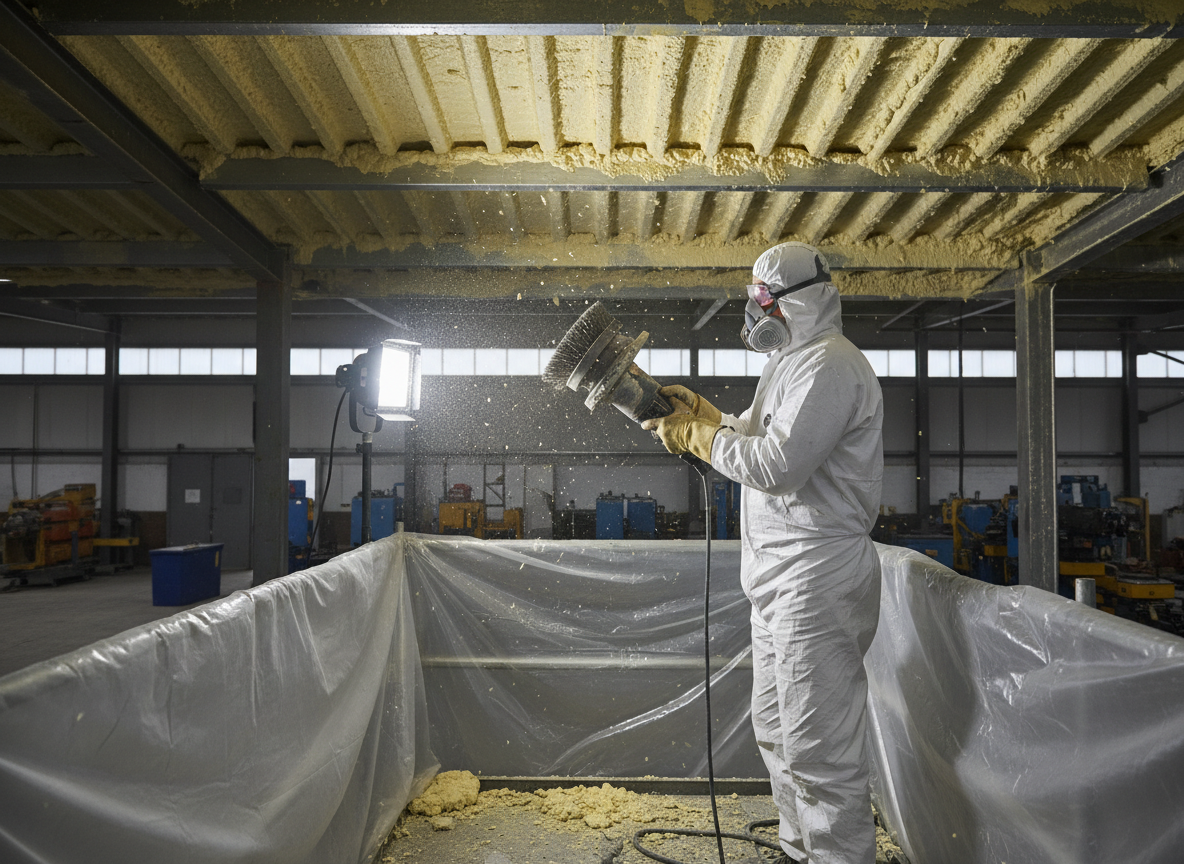
Commercial buildings in Plymouth often feature post-war concrete frames or Victorian warehouses where spray foam was applied to roof decks and cavity walls for quick insulation. Over time the material traps moisture from the area's frequent rain and salt-laden air, leading to hidden corrosion on steelwork and degradation of timber joists. Removal requires careful sectioning to avoid releasing fibres into ventilation systems that serve multiple tenancies.
Edge cases include foam bonded directly to asbestos-containing soffits common in 1960s industrial units around the dockyard area. We isolate and bag material on-site before disposal at licensed facilities, following current Devon waste regulations. Electrical trunking and sprinkler runs frequently run through the foam layer, so we map services first to prevent damage that could halt operations for days.
Plymouth's exposed coastal position means wind-driven rain can penetrate failed roof membranes above foam, creating saturated pockets that standard removal tools cannot reach without additional drying time. We use moisture meters at multiple depths before final clearance to ensure the substrate is dry enough for new insulation or coatings. This step prevents callbacks when new tenants fit out the space.
Technician insight
In Plymouth the thing that catches most people out with Commercial Spray Foam Removal is how quickly coastal damp gets behind foam on flat roofs of 1970s units near the Hoe. One missed wet patch and the new membrane fails within two winters.
Warehouse Roof Deck in Stonehouse
A commercial unit near Millbay had spray foam delaminating from the concrete roof deck after years of trapped condensation. We found saturated insulation over steel beams and mapped live services before cutting. Sections were removed under negative pressure, the deck dried for 48 hours, and the space was handed back ready for new roofing without interrupting the tenant's storage operations.
How it works
- 1
Site Survey and Risk Assessment
We inspect the commercial property, identify foam locations, test for hidden services and note access constraints typical of Plymouth's older industrial stock.
- 2
Containment and Extraction
Temporary barriers protect occupied areas while foam is cut and removed in sealed sections to limit dust spread in busy commercial environments.
- 3
Substrate Cleaning and Drying
Remaining residue is cleaned from decks and walls; moisture readings confirm the structure is ready for new works or coatings.
- 4
Waste Disposal and Handover
All material is taken to licensed sites with full documentation; the space is left clean for immediate access by other trades.
Pricing
Scope depends on building size, foam depth and access; we provide upfront quotes after survey.