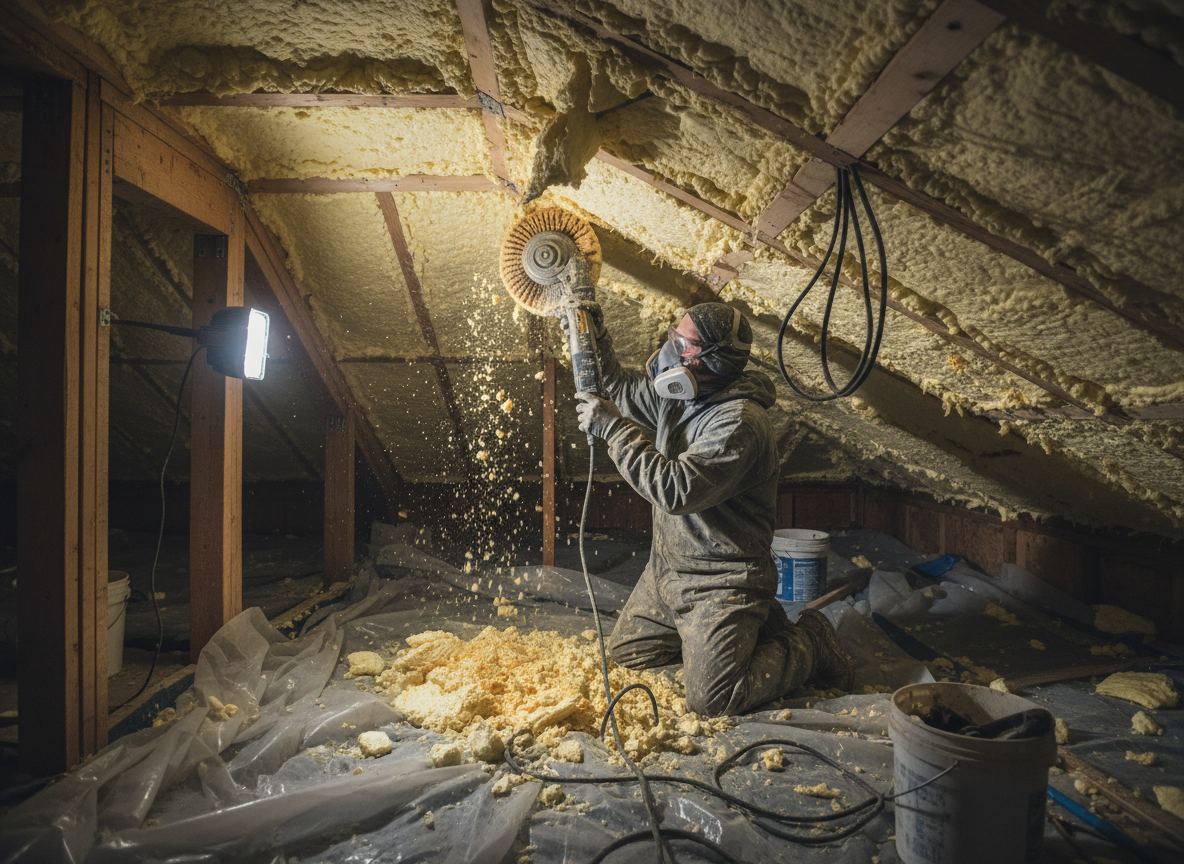
Plymouth's housing stock includes many pre-1970 terraced and semi-detached homes where spray foam was installed in lofts during the 1980s and 1990s. The maritime climate brings frequent damp air and wind-driven rain that can become trapped once the foam seals the roof space. Homeowners often notice black mould on rafters or peeling plaster on top-floor ceilings once the foam begins to degrade. Removal requires careful cutting and vacuum extraction to avoid damaging original lath and plaster ceilings common in areas such as the Barbican and Stoke. Restoring airflow through eaves and ridge vents is essential to prevent recurrence of condensation once the foam is gone.
Different foam types behave differently in Devon properties. Closed-cell foam bonded to felt underlays in post-war council houses around Efford and Whitleigh often pulls felt away during removal, requiring new underlayment. Open-cell foam in Victorian villas tends to crumble and leave residue on joists that must be brushed and vacuumed before new insulation can be installed. Local Building Control expects ventilation to be reinstated to current standards after removal, especially in properties converted into flats where fire separation must remain intact. Working around existing electrical cables and water pipes running through lofts adds time and care in these older buildings.
Access is frequently restricted in Plymouth's narrow terraced streets where scaffolding or internal loft hatches limit equipment size. Coastal salt air accelerates corrosion on any metal fixings left in place, so all brackets and fixings are checked and replaced where needed. Homeowners in Mount Gould and Plymstock regularly report that once foam is removed the roof space temperature drops noticeably in winter, confirming the original insulation had been blocking intended ventilation paths. Final clearance includes debris removal and a full clean-down so the loft can be reinspected before any new works begin.
Technician insight
In Plymouth, the thing that catches most people out with Spray Foam Removal near me is how the salt-laden air has already corroded the felt underlay beneath closed-cell foam in 1960s terraces around Keyham and Devonport. Once you start pulling the foam the felt comes away in sheets, turning a straightforward extraction into an unplanned roof repair that must be done before the next storm arrives.
Loft Foam Removal in a Stoke Terrace
Homeowner in a 1930s terraced house reported persistent ceiling stains after heavy winter rain. Inspection found closed-cell foam bonded to degraded felt with blocked eaves. We removed the foam, replaced the affected felt sections, cleared all vents and restored airflow. The loft dried out within weeks and no further staining appeared.
How it works
- 1
Site Assessment
Inspect loft or wall cavities, identify foam type and thickness, and check for existing damp or electrical issues.
- 2
Containment Setup
Seal work area with plastic sheeting and negative air to prevent dust migration into living spaces.
- 3
Foam Extraction
Cut and remove foam in sections using specialist tools, then vacuum residue from rafters and joists.
- 4
Ventilation Restoration
Clear eaves, install or repair vents, and ensure ridge ventilation meets current standards.
- 5
Final Clearance
Remove all debris, clean surfaces, and conduct walkthrough with homeowner before sign-off.
Pricing
Cost depends on property age, foam depth, access difficulty and whether ventilation repairs are required. Quotes are provided after inspection.