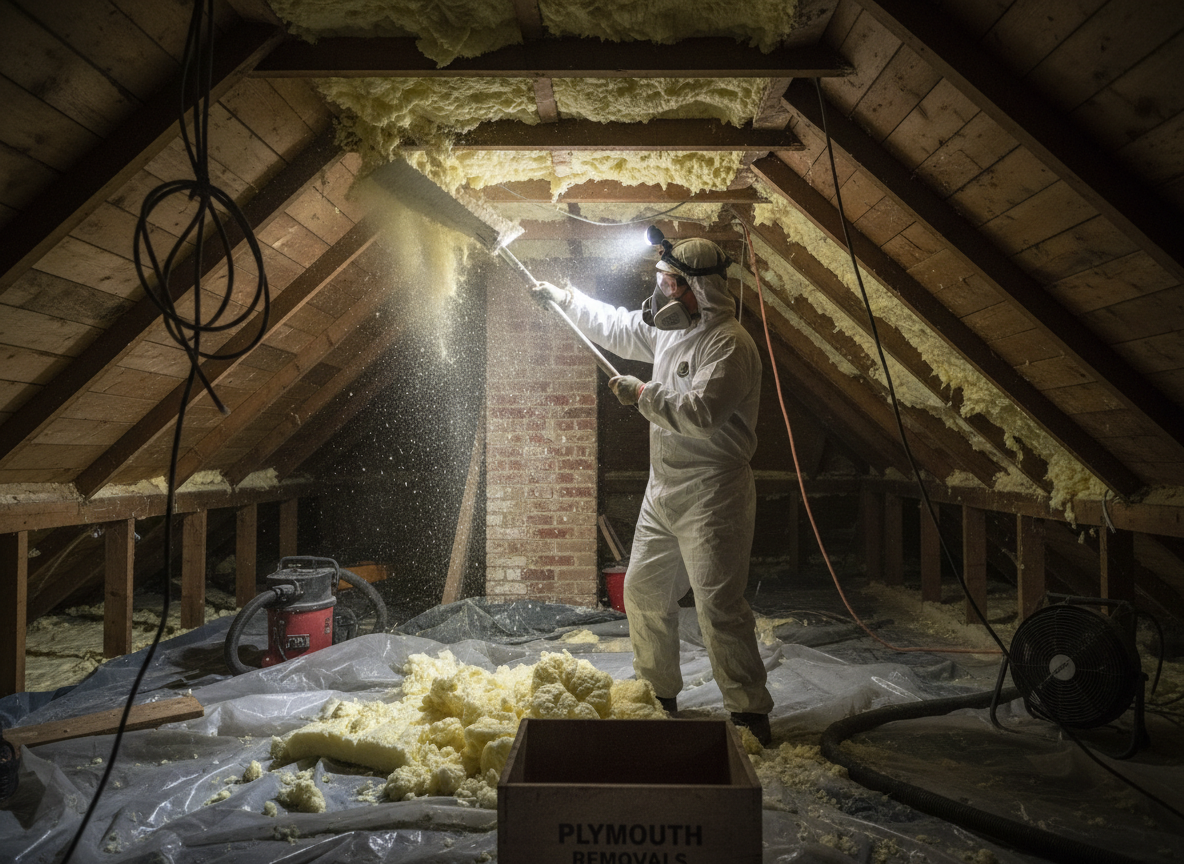
Open cell spray foam was widely applied in Plymouth properties built between the 1920s and 1970s, especially in terraced houses around Mutley, Lipson and the Barbican where roof voids and wall cavities were hard to insulate any other way. Over time the material absorbs moisture from Devon's frequent driving rain and high coastal humidity, leading to reduced thermal performance and hidden timber decay behind lath and plaster ceilings. Removal requires careful sectioning with oscillating tools to avoid disturbing original lathe work or asbestos-containing artex ceilings common in these homes.
Extraction crews working from 32 Mayflower St routinely encounter foam that has bonded directly to slate roof undersides and single-skin stone walls found throughout the PL1 and PL2 postcodes. Once cut free, the foam must be bagged immediately to prevent loose particles drifting into living spaces below; negative air machines are essential in the narrow stairwells of Victorian terraces. Homeowners often discover the job expands once the first section is removed and reveals staining or rot that was masked by the foam.
Local building control in Plymouth requires notification when insulation is stripped from pre-1919 properties because the original ventilation paths must be reinstated to meet current moisture management standards. Failure to restore eaves and ridge ventilation after removal can create condensation problems in the mild but persistently damp Devon winters. Crews therefore document existing airflow routes before starting and photograph the restored state for the homeowner's records.
Technician insight
In Plymouth the thing that catches most people out with open cell spray foam removal is how the foam has wicked moisture into the single-skin stone walls that are everywhere in the older terraces around the Hoe and Stonehouse. Once you start pulling it you find the original lime pointing has already started to fail and the job suddenly includes repointing work before you can even think about re-insulating.
Lipson Terrace Void Clearance
Homeowner in a 1930s terrace noticed musty smells after heavy winter rain. Inspection found open cell foam fully saturated against the rear stone wall with visible rot on joist ends. Crews sectioned and removed the foam, restored ridge and eaves ventilation, then treated the timber. Property now has dry cavities and improved airflow.
How it works
- 1
Site Survey and Moisture Mapping
Technicians inspect the property from 32 Mayflower St base, checking roof voids, wall cavities and any visible staining in Plymouth homes.
- 2
Containment and Dust Control
Plastic sheeting and negative air units are installed to protect living areas in older terraced houses common across the city.
- 3
Sectioned Removal
Open cell foam is cut into manageable pieces using oscillating blades and extracted without damaging original lathe or stonework.
- 4
Ventilation Reinstatement and Final Clean
Eaves, ridge and underfloor vents are cleared or added back to match Devon coastal conditions before debris is removed.
Pricing
Cost depends on property age, foam depth and access difficulty in Plymouth's older housing stock; quotes are provided after inspection.