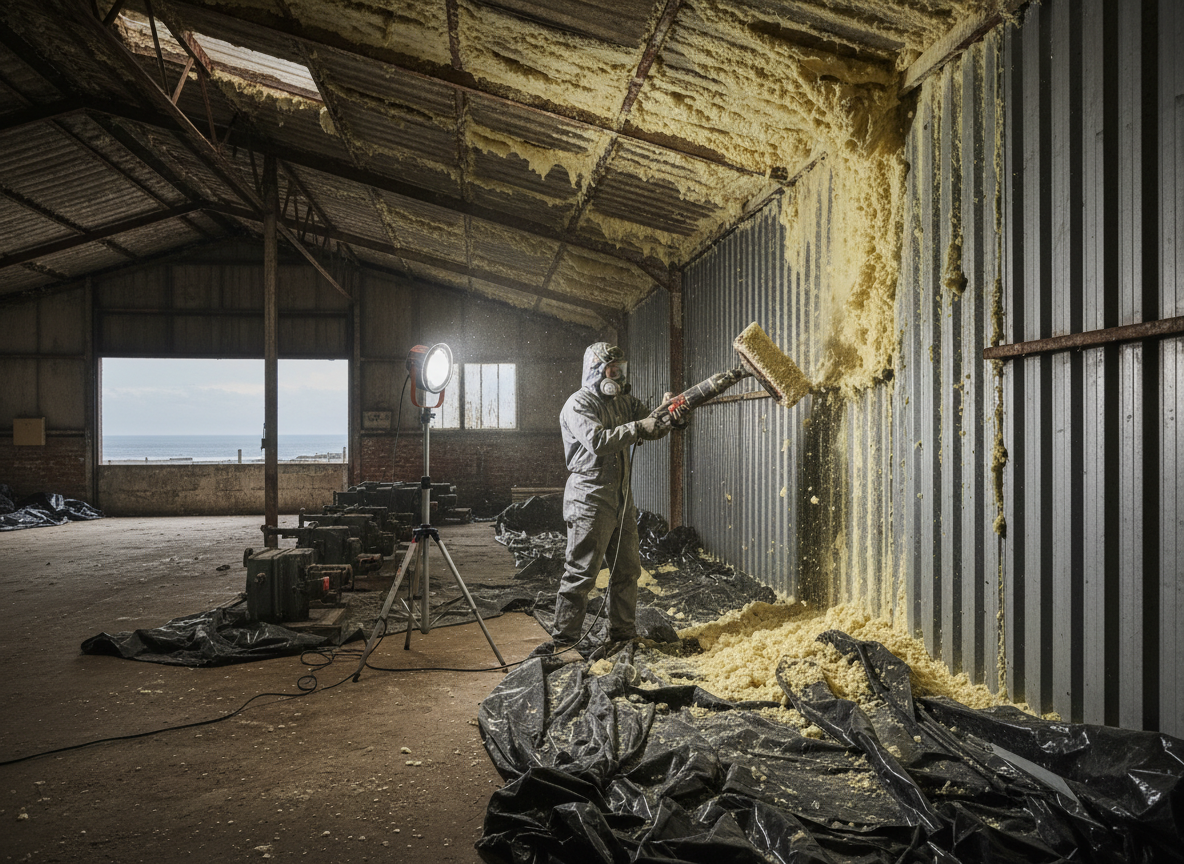
Plymouth warehouses, many built around the naval dockyards and Barbican waterfront, frequently contain spray foam applied decades ago for insulation on metal roofs and concrete walls. Coastal humidity and salt air cause the foam to bond tightly to substrates and trap moisture, leading to hidden corrosion and mould growth that standard demolition methods cannot address without spreading particles. Removal requires sequential mechanical separation combined with negative air containment to protect adjacent storage areas and meet UK hazardous waste handling rules for isocyanates.
Edge cases arise in multi-level stone and brick warehouses near Stonehouse and Mutley where foam was injected into cavities. Here the material often expands behind load-bearing timbers, risking structural damage if pulled too aggressively. Technicians must map foam depth with borescopes first, then use solvent softening only on non-porous surfaces while ventilating to prevent vapour buildup in enclosed spaces that lack modern airflow.
Disposal routes in the Plymouth area are constrained by local landfill acceptance criteria for construction waste containing residual chemicals. All removed foam must be double-bagged on site and transported to permitted facilities rather than general skips. Owners should expect the job to take longer than residential loft work because warehouse scale and restricted access points around loading bays add staging and equipment movement time.
Technician insight
In Plymouth, the thing that catches most people out with Warehouse spray Foam removal is how the constant damp from the Tamar estuary and prevailing south-westerly winds makes the foam grip steel purlins far tighter than it does inland, so you end up spending extra time softening every joint instead of just scraping.
Waterfront Warehouse Foam Strip-Out
A storage unit near the Hoe showed bubbling foam on the roof deck. Inspection revealed trapped moisture and early rust on the steel. We isolated the bay, removed the foam in sections with solvent assist, treated the metal, and cleared the space without affecting neighbouring units.
How it works
- 1
Site Assessment
Inspect foam condition, substrate type, and moisture levels throughout the warehouse using borescopes and moisture meters.
- 2
Containment Setup
Install negative air machines and floor-to-ceiling barriers to isolate the work zone from stored goods and occupied areas.
- 3
Foam Extraction
Remove foam in controlled layers with mechanical scrapers and approved solvents while monitoring air quality.
- 4
Surface Preparation
Clean residues from metal and concrete, treat corrosion spots, and verify the space is ready for new insulation or repairs.
- 5
Waste Removal
Bag and label all material for compliant transport to authorised Devon disposal sites.
Pricing
Upfront quotes based on warehouse floor area, foam thickness, and access restrictions; no hidden fees.